When Kids’ Screen Time Is Up, Why We Don’t Just Lock the Screen
The usual way to build a screen-time tool is simple: time’s up, the app closes, done. Cut off mid-game like that, a kid melts down — tears, arguing, the works.
Tortoise Time doesn’t do that. As the limit gets close, it gives a few gentle nudges first, leaving time to finish the level or the episode on screen — it only really locks at 100%. One less fight.
When exactly does it nudge?
| Getting close | What happens |
|---|---|
| At 60% / 75% / 90% | A small banner at the top for a few seconds — no interruption |
| At 100% | It actually locks |
One thing to get straight first, because plenty of writing on this subject (including an earlier draft of this page) overstates it: it is not true that every other tool cuts out with zero notice. Google’s Family Link documents that it notifies the child when the device is about to be locked — it just doesn’t say how many minutes of notice that is. Android’s built-in app timers are the stricter case: the app closes and its icon dims, and no advance warning is described in Google’s documentation for them. We read through each option’s own pages in a separate piece.
So the honest question isn’t “who slams the door.” It’s how much notice, how it arrives, and who has to deliver it.
A different design choice
A child’s attention is like a small stream — it has a beginning, a rhythm, and a natural place to stop. If you throw up a dam halfway through, the water doesn’t slow down — it splashes: the emotions spill out first — tears, protests, bargaining.
So we chose a different approach: gradual tightening, not sudden cutoff.
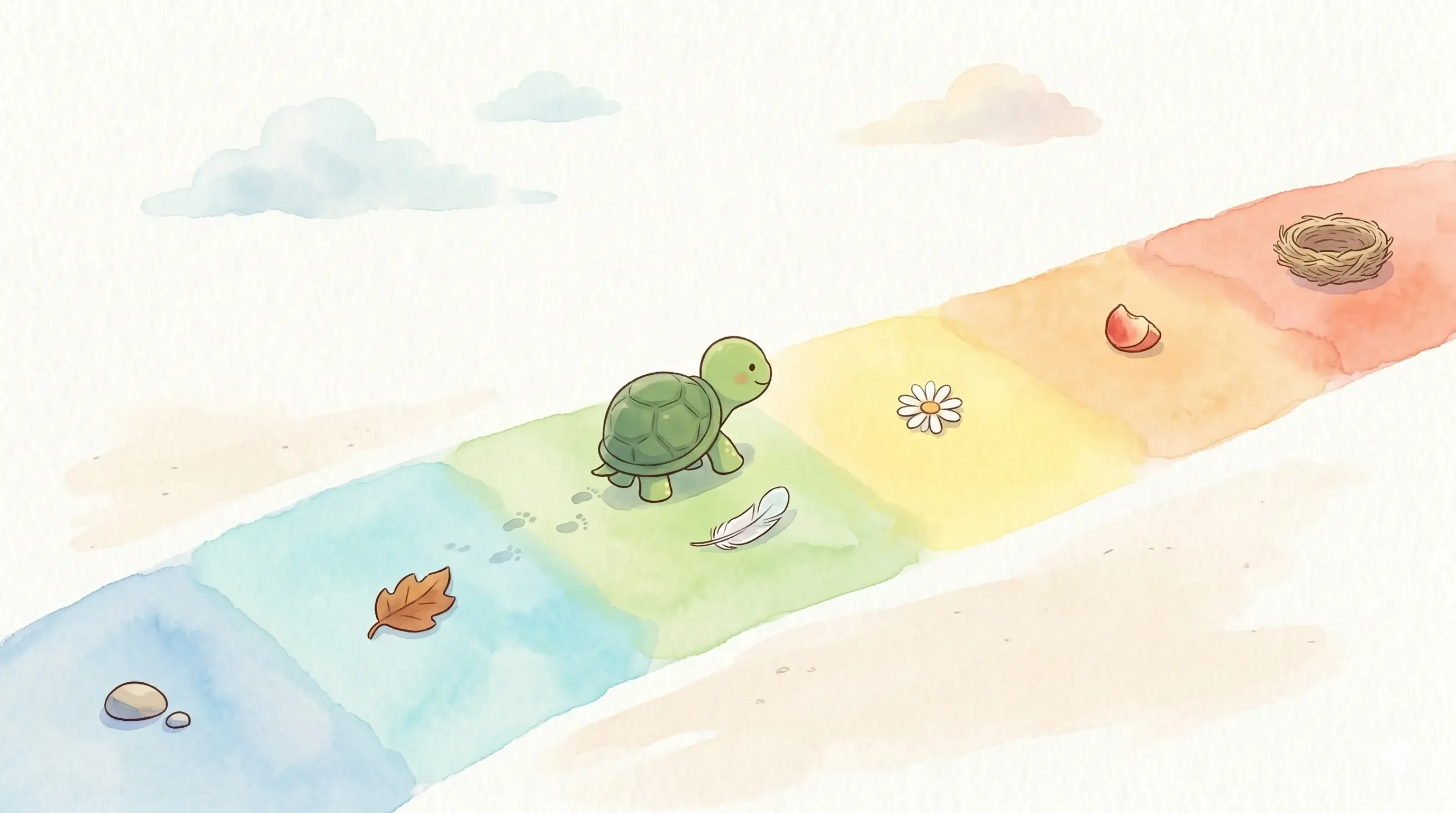
6 stages in a day
As a child uses an app, they move through a series of progressively firmer reminders:
- Normal use — no reminders at all. This is the child’s exploration time.
- Gentle Reminder — a soft banner slides across the top of the screen, doesn’t interrupt the game, just says “hey, heads up”
- Friendly Reminder — the banner stays a bit longer, the tone is a little more direct: “time to start wrapping up”
- Serious Warning — the banner lingers longer, the message is clearer: “please get ready to stop”
- Time’s Up — this is when the full-screen block finally appears. The child needs a parent PIN to continue.
- Overtime (past 105%) — the block stays up, and you receive a parent alert notification
These aren’t 6 separate “features.” They’re 6 psychological transitions through the same event. We believe children have the chance at every stage to stop on their own — not because they were forced to.
What the evidence actually supports — and where we’re guessing
I’d rather show you the research than assert a philosophy, including the part that cuts against us.
Nobody credible will give you the magic number. The American Academy of Pediatrics is explicit that its evidence-based guidance does not set a screen time limit that applies to all children and teens, and says there isn’t enough evidence showing a benefit from specific limit guidelines. Its advice is to weigh the quality of what a child is doing rather than the quantity alone, and to notice whether media is crowding out sleep or physical activity. The AAP’s 2026 explainer of its current policy puts it the same way — the guidance has moved past simple screen-time limits toward quality, context and conversation.
That matters for what a tool like this can honestly claim. The daily limit you set is your judgment call, not a clinical threshold, and we don’t pretend otherwise. What software can help with is the transition — the two minutes where it actually falls apart.
The uncomfortable finding. Researchers at the University of Washington ran an interview study with 27 families and a two-week diary study with 28 more, and reported that giving a two-minute warning made transitions worse, not better. That is a direct challenge to any product built on advance warnings, and I’m not going to bury it.
Two things kept it from changing our mind, and you should judge whether they hold up:
- The children in that study were aged 1 to 5. Tortoise Time is built for ages 6 to 14, and as far as I can find, nobody has run the equivalent study on older kids. Neither their result nor our design is established for a nine-year-old.
- What the same researchers found did help points at the design directly: routines and predictable schedules, and natural stopping points in the content or the game — being able to finish the episode or clear the level rather than abandon it. A limit that announces itself in stages, at the same fractions of the same limit every day, is an attempt to be that predictable schedule; a block that waits until 100% is an attempt to leave room for the level to end.
There’s also a plausible reading that the problem in that study wasn’t the warning but the messenger — a parent interrupting, which turns the transition into a negotiation with a person who can be argued with. We go through that argument in more depth in Why Kids Melt Down When Screen Time Ends. Worth keeping in proportion: in the same study, 59% of transitions happened with no resistance at all, which suggests parents dread these moments more often than they actually go wrong.
On the “several nudges” part specifically. Children and Screens, an independent nonprofit, recommends in its transition tip sheet giving incremental warnings ahead of a transition rather than one, and saying what comes next — and notes that children do well with consistency and structure. That’s practice guidance rather than a controlled trial, and it’s worth reading as such.
Where that leaves us: the staged design is a considered bet, not a proven result. If your child does better with a single hard stop, that’s a legitimate finding about your child, and no study here contradicts it.
Why this matters
Forced lock-out is easy to build, and it’s “effective” on the surface — the time is technically controlled.
But what children learn from that kind of tool is: time is something other people impose on you, not something you manage yourself. Use it long enough, and children either learn to fight back or learn to work around it. If that sounds abstract, it’s the practical problem behind how a kid gets around a screen-time app — the tighter and more arbitrary the wall feels, the more the effort goes into the wall.
What we want children to learn instead is: time has a rhythm — the closer you get to the end, the more it makes sense to slow down. 6 stages give children the full arc of “it’s almost over” — without taking away their chance to stop on their own terms.
A word for parents
If your child usually waits until the last stage before stopping — that’s completely normal. Adults do the same thing. If your child stops on their own in the earlier stages — that’s a very good sign. They’re learning to manage themselves.
Either way, don’t conclude the approach isn’t working just because your child reached “Time’s Up.” The 6-stage progressive reminder isn’t measuring “did the child stop on time” — it’s measuring “has the child learned to sense time passing.”
And if the reaction at the end is big enough that you’ve quietly wondered whether something’s wrong, that question has its own page, with the actual thresholds clinicians use: Why Your Child Gets Angry When You Turn Off the Tablet.
Written by a parent who builds Tortoise Time, an Android screen-time app for kids aged 6 to 14. It nudges quietly at 60%, 75%, and 90% of the daily limit before blocking anything at 100%. It’s free, with no ads and no in-app purchases. Your child’s screen-time data stays on the phone by default — the only things that leave the device are pseudonymous crash diagnostics and usage events, as our privacy policy says. Nothing here is medical advice.
This piece describes our product philosophy, not specific how-to instructions. Want to see how it works day to day? Read A Day in the Life and FAQ.
Sources
Retrieval level noted for each, because it changes how much weight a claim can carry.
- “Screen Time Guidelines.” American Academy of Pediatrics, Center of Excellence on Social Media and Youth Mental Health, Q&A Portal. (Full page retrieved. Source for the absence of a universal limit, the statement about insufficient evidence for specific limit guidelines, and the quality-over-quantity framing.)
- “Helping Kids Thrive in a Digital World: AAP Policy Explained.” HealthyChildren.org, American Academy of Pediatrics. Last updated June 3, 2026. (Full page retrieved. Source for the move beyond simple screen-time limits toward quality, context and conversation, and for the school-age harms list.)
- Hiniker, Alexis, and Julie Kientz, University of Washington. “Two-minute warnings make kids’ screen time tantrums worse.” UW News, May 5, 2016. (Full page retrieved. 27 family interviews plus a two-week diary study with 28 families; children aged 1–5. Source for the two-minute warning result, for routines and natural stopping points helping, and for the 59% figure. University news summary of the research, not the paper itself.)
- “Shifting Off Screens.” Children and Screens: Institute of Digital Media and Child Development, parenting tip sheet, February 2022. (Full page retrieved. Source for incremental warnings, saying what comes next, and consistency and structure. Practice guidance, not a peer-reviewed study. Discussed at more length in our companion piece.)
- Family Link and Android app-timer behavior is sourced from Google’s own help pages, listed in full in How to Make Android Warn Your Child Before Screen Time Ends.
Not established: whether staged, device-delivered reminders help children aged 6 to 14. I could not find a study testing it. The design is reasoned from evidence about younger children and from practice guidance, which is a weaker basis than a trial, and I’d rather say so than imply otherwise.